
"We already do PBIS. We already have an SEL curriculum. Why would we need The Regulated Classroom® and where would it fit?"
It's a common question from principals and district leaders, and it's a fair one. Schools are weary of new initiatives that ask them to start over. The short answer: The Regulated Classroom® doesn't have to replace PBIS or your SEL program. It sits underneath them.
Top-down and bottom-up
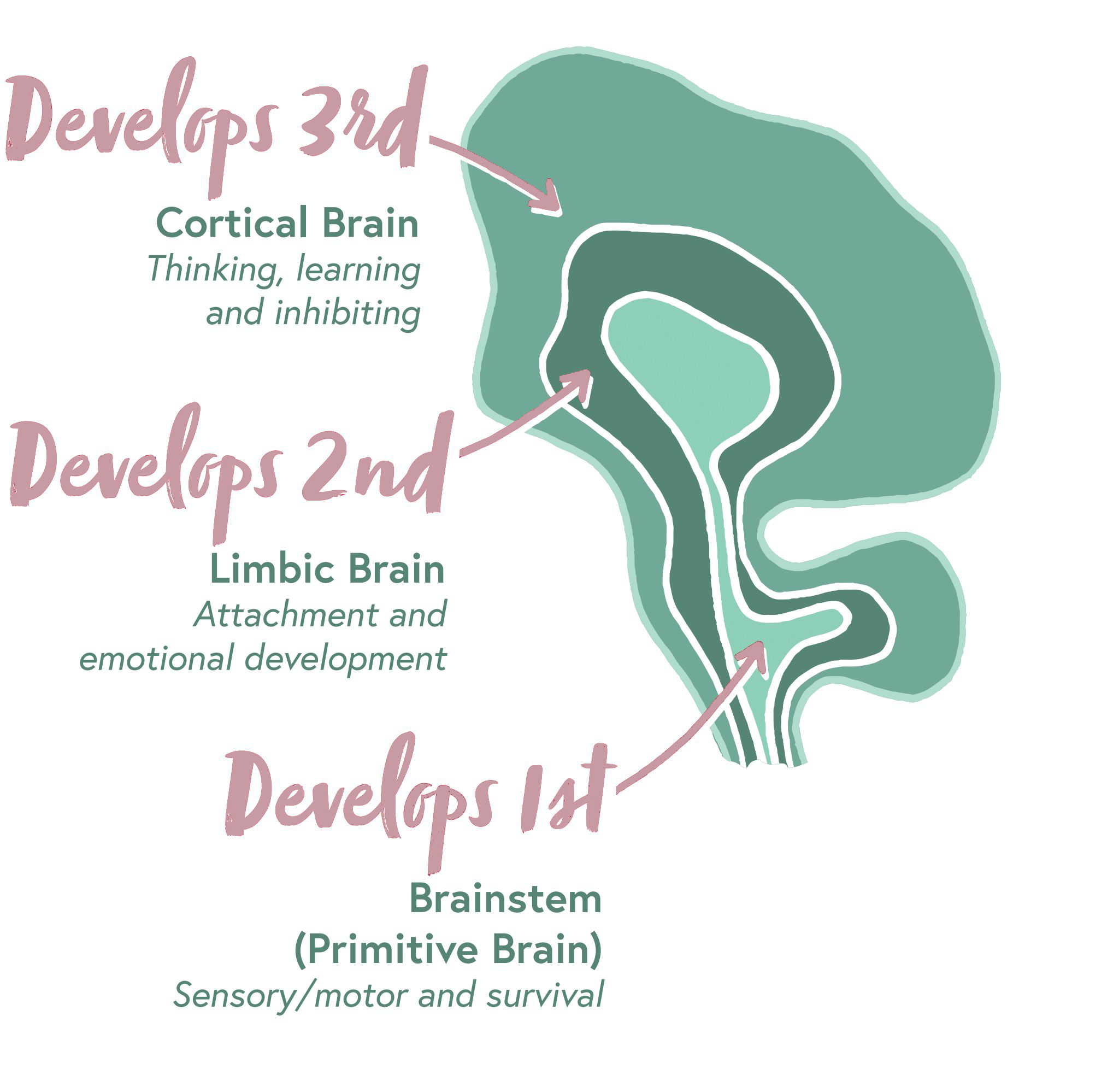
Figure A: The sequence of how the brain grows and develops
Most behavior and social-emotional approaches work from the top down—seeking to regulate emotions and behavior through access to the “top part” of the brain. SEL and PBIS intend to influence the top of the brain (neo cortex—i.e. cortical brain) to regulate lower regions of the brain, like the brainstem (i.e. “top down.”).
PBIS & SEL rest upon assumptions that if students know better, they’ll do better. In The Regulated Classroom®, we recognize these expectations as social norms and etiquette. Social norms and etiquette are culturally specific, require explicit teaching and respond well to positive reinforcement. But social norms & etiquette reside in parts of the brain that are only fully available when a person feels safe.
The brain grows and develops from the bottom up. A student who is in fight-or-flight, or who has shut down, can't consciously access a lesson on self-management, no matter how good the lesson is.
The same is true for the teacher. In Polyvagal terms, we are only "socially enabled" when our nervous system is regulated. This is why The Regulated Classroom® works from the “bottom up.”
Dr. Stephen Porges, author of Polyvagal Theory, says the vast majority of pro-social behavior (i.e. helping, cooperating, caring, sharing, kindness, turn-taking, comforting, face-to-face communication, etc.) emerges spontaneously from a regulated nervous system. This is why regulating the nervous system can enhance the outcomes of other programs while also reducing teacher stress and burnout.
The 4 Core Practices (Connectors, Activators, Settlers and Affirmations) of The Regulated Classroom® use rhythm, movement, play, laughter and calm to gently arouse and settle the nervous system. Done regularly, they widen what Dr. Dan Siegel calls the window of tolerance: the range in which students and adults can stay present, think clearly and connect. And because co-regulation starts with the adult, we always begin with the teacher.
The Regulated Classroom® and PBIS
Positive Behavioral Interventions and Supports is a three-tiered framework, not a curriculum. As the Center on PBIS explains, it is an ongoing commitment to systems change, built on data and a continuum of evidence-based practices. That's exactly why The Regulated Classroom® fits inside it: we offer practices, and PBIS gives schools the system to use them consistently.
Tier 1 (all students): The 4 Core Practices become part of the daily rhythm in every classroom, such as a CONNECTOR during morning meeting or a SETTLER after recess or lunch. A regulated room is a room where students can hear, remember and follow the expectations you've taught.
Tier 2 (some students): Before engaging in a targeted intervention, facilitate a nervous system reset. Many pair a quick SETTLER or ACTIVATOR with check-in/check-out, so the conversation starts from a regulated state.
Tier 3 (a few students): Students with the most intensive needs often spend much of the day in a stress response. A nervous system perspective offers a new lens to help teams see what behavior is communicating (it’s more than just seeking or avoiding). Moreover, it can redirect attention to interventions that support sequential development and improve physiological functioning of the nervous system (i.e. safe and sound protocol, NMT, bal a vis X, etc.)
PBIS also asks schools to support the adults. Our teacher-first approach means educators regulate themselves with their students through practices of co-regulation, which helps with the burnout that so often stalls implementation.
The Regulated Classroom® and your SEL program
Most SEL curricula teach toward the CASEL 5: self-awareness, self-management, social awareness, relationship skills and responsible decision-making. A typical lesson runs 20 to 30 minutes. The teacher introduces a skill through a story, video or puppet, models it, and has students practice through discussion, role-play or a worksheet before reflecting on what they learned. It's valuable work, and nearly all of it asks students to listen, talk and plan. That works well when students are regulated enough to take it in.
The Regulated Classroom® builds that readiness. Students practice regulation in their bodies through rhythm, movement and play, then bring that steadiness into the SEL lesson. A few minutes with a SETTLER before a lesson on managing frustration means students can practice the skill instead of just hearing about it. CASEL also calls for strengthening adults' own social and emotional capacity. That is where we start.
Whether your school uses Second Step, RULER, Responsive Classroom, Conscious Discipline, or a program of its own, The Regulated Classroom® works alongside it. You keep your lessons and your language. We add the nervous system foundation underneath.
How the three fit together
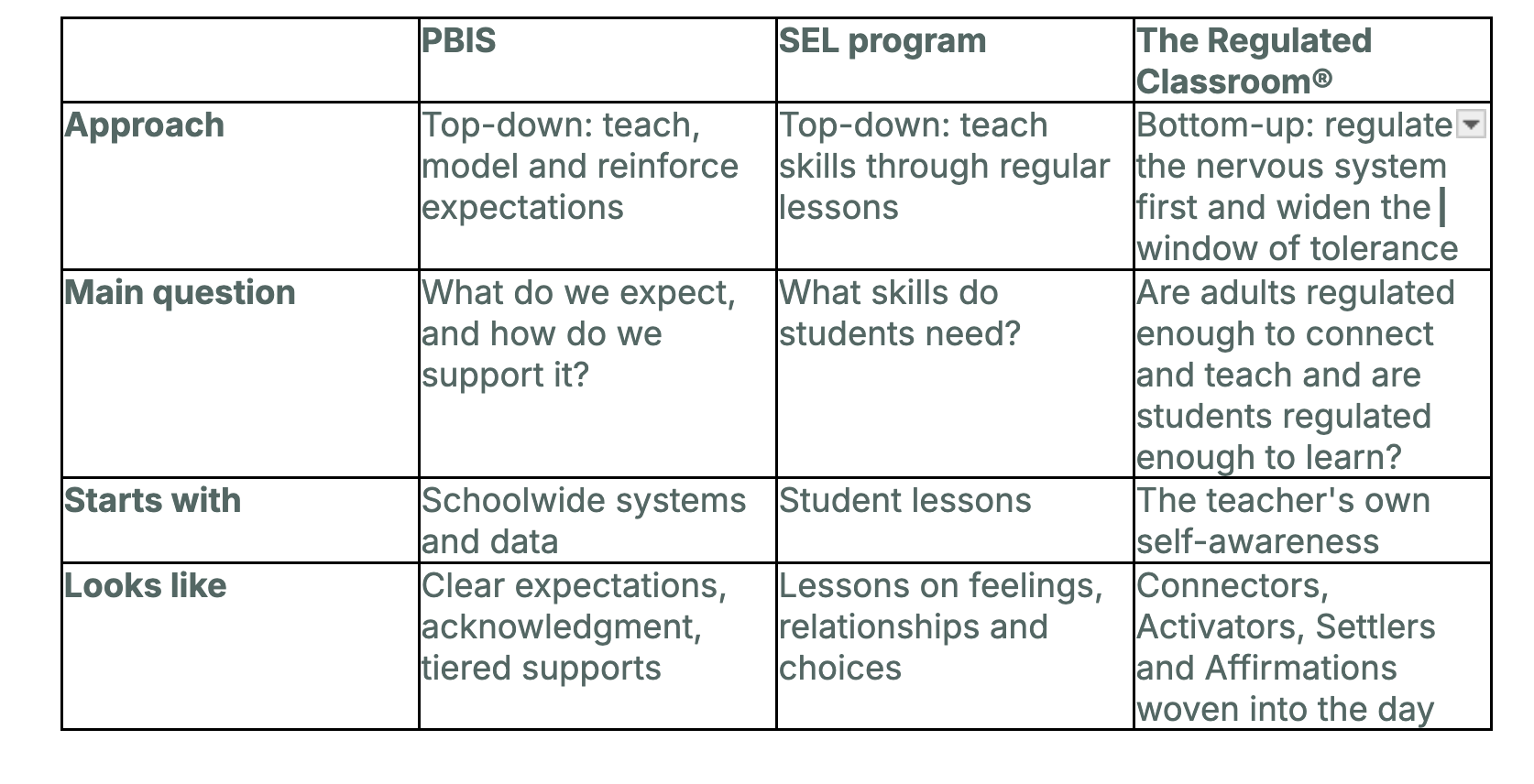
Connectors, Activators, Settlers and Affirmations woven into the dayPicture a Monday morning. The class opens with a CONNECTOR—a quick practice of Gotcha then Evolution that gets everyone laughing. The teacher reviews the week's PBIS expectation. After a SETTLER practice students move into their SEL lesson ready to listen. Nothing was replaced. Each piece just works better.
Start where you are
You don't need to choose between your behavior framework, your SEL curriculum and regulation. The work you've already built is worth keeping. The Regulated Classroom® helps it reach the students and adults who have been too stressed to take it in.
Want to see how this could look in your school or district? Visit regulatedclassroom.com to explore our trainings, licensing options and educator resources, or reach out to talk with our team. We practice what we teach: "you matter" starts with us.