
The Framework
Let’s co-regulate!
The Regulated Classroom® provides educators with an evidence-based framework that enables co-regulation between teachers and students.
The framework helps educators understand the specific qualities of experience that reset or regulate the nervous system, thereby enabling prosocial behavior and learning.
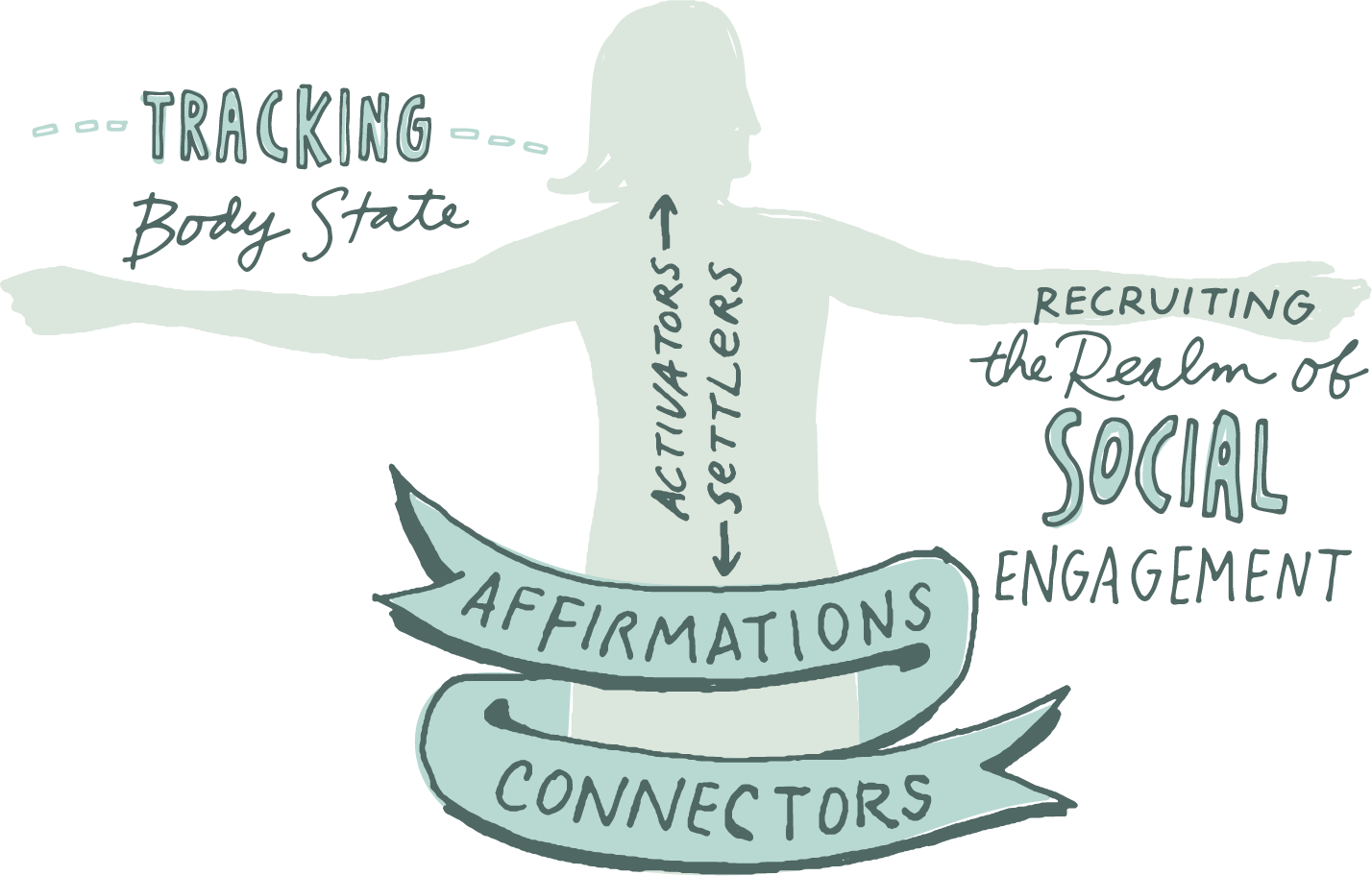
The 4 Core Practices of the TRC® framework represent distinct developmental experiences that buffer stress and trauma and support sequential growth and development.
Simply put, the 4 Core Practices (i.e. CONNECTORS, ACTIVATORS, SETTLERS, AFFIRMATIONS) are micro-moments of co-regulation that reset everyone.
Nerd Moment
What does it mean to be regulated?
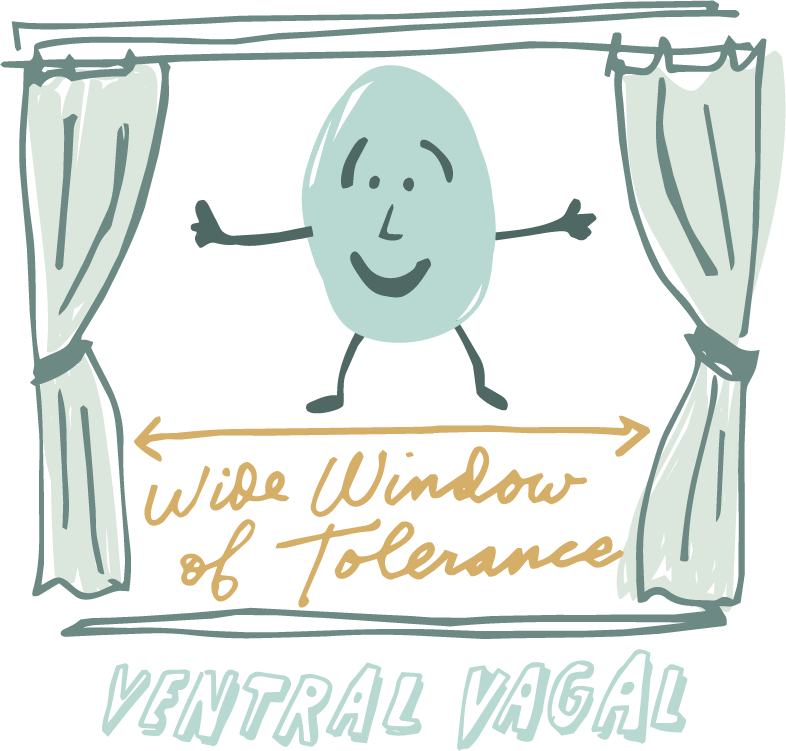
Being regulated means being able to respond instead of react in any given moment. It means you are operating within your window of tolerance (Siegel, 1999). It reflects a balanced state in your nervous system and is often described as feeling safe or felt safety. When we feel safe, we are socially enabled.
What is Polyvagal Theory ?
Dr. Stephen Porges, a distinguished scientist, first proposed The Polyvagal Theory in 1994 with his revolutionary map of the nervous system. The theory proposes three primary circuits of the autonomic nervous system—ventral vagal, sympathetic, and dorsal vagal states— that influence our behavior and feelings.
Chronic stress, trauma, insufficient developmental experiences, and other circumstances can prevent our autonomic nervous system from functioning in a modulated rhythm, keeping us stuck in hyper or hypo states of arousal. Living in these prolonged states of survival often leads to unhealthy adaptive behaviors and significantly increases our risk for chronic disease and mental illness.
In The Regulated Classroom® (TRC®), we apply the principles of Polyvagal Theory to our framework. We teach educators how to track their nervous system states, thereby enabling them to shift state when they begin to notice bodily cues of dysregulation. We also teach them how to recruit the realm of social engagement with their students and colleagues through relational and environmental cues of safety in the classroom.
Moreover, we teach educators how to incorporate TRC® 4 Core Practices into their daily routines to allow for frequent and repetitive experiences of co-regulation throughout their day.
The Regulated Classroom® vs. Traditional Social Emotional Learning (SEL)
The Regulated Classroom®
The Regulated Classroom® begins by focusing on the adult nervous system— establishing a foundation for co-regulation where learning can occur.
The Regulated Classroom© acknowledges that not all behavior is a choice.
Reflexive fight, flight, or freeze reactions situationally block the ability to make a conscious choice in the moment.
The Regulated Classroom© is based on practices and tools to restore balance in the nervous system, thereby establishing felt safety and regulation.
The Regulated Classroom aims to widen the window of tolerance through experiences that will physiologically recalibrate how the nervous system functions.
The Regulated Classroom© is a collection of practices (4 Core Practices) that up regulate and down regulate the nervous system. These practices are embedded in classroom routines and applied with great frequency & repetition on a daily basis.
The Regulated Classroom© is primarily informed by the work of Dr. Stephen Porges—Polyvagal Theory, the work of leading neuroscientists and psychiatrists (i.e. Dr. Bessel van der Kolk, Dr. Bruce Perry, etc.), the fields of occupational therapy, attachment theory & play science, developmental & somatic psychology, along with the applied science of trauma.
Traditional Social-Emotional Learning (SEL)
Traditional SEL focuses on student behavior.
Traditional SEL programs view bad behavior as a skills deficit.
Traditional SEL relies on a student's ability to assess a situation, think clearly & rationally, and make a better choice in the moment.
Traditional SEL programs are often curriculum-based, focused on students developing skills to assess situations and then apply learned behaviors.
Traditional SEL programs commonly include lesson plans presented at scheduled SEL instructional time, once a week.
Traditional SEL programs are primarily informed by the fields of cognitive psychology, educational psychology, and implementation science.
“The Regulated Classroom offers educators a beautifully integrated approach, fostering student behavioral regulation through structured experiences designed to provoke joy, wonderment, and curiosity.
By providing playful opportunities as efficient neural exercises, it enhances the students’ neural platform for sociality, cognitive growth, and optimal mental health, facilitating effective learning and social development.”
- Dr. Stephen Porges, author of Polyvagal Theory