

Ideas for Working with a Student in Shutdown or Dorsal State
I am certain you can picture a student in class in a shut down state.

Head down.
Shoulders slumped.
Curled inward.
Unresponsive.
In a fast-paced classroom environment with high expectations, a student in shutdown is a threat to educator success.
As a former school counselor, I vividly recall these circumstances. I was frequently summoned by the principal or a teacher to intervene with a student in shutdown. I met this challenge with high energy, hoping to elicit a response from my student.
With an upbeat tone of voice I would say, “Hey buddy, how’s it going? Looks like you’re struggling.”
Most of the time, I got silence or the occasional eye roll. In retrospect, it’s because I misunderstood what I was encountering.
I used to think that kids who shut down were attempting to gain power, get attention or avoid something undesirable. I viewed shutting down as a silent version of a temper tantrum. It didn’t occur to me that it may have been an involuntary attempt at safety or protection.
Dr. Stephen Porges, author of Polyvagal Theory, offers a revolutionary perspective to help us reinterpret this type of challenging behavior. Porges argues that shutting down is an ancient form of protection in our nervous system. When we encounter a threat that we can’t mobilize against, we shut down and converse energy. As The Regulated Classroom® figure A below depicts, when we shut down we drop into a dorsal vagal state in the nervous system.
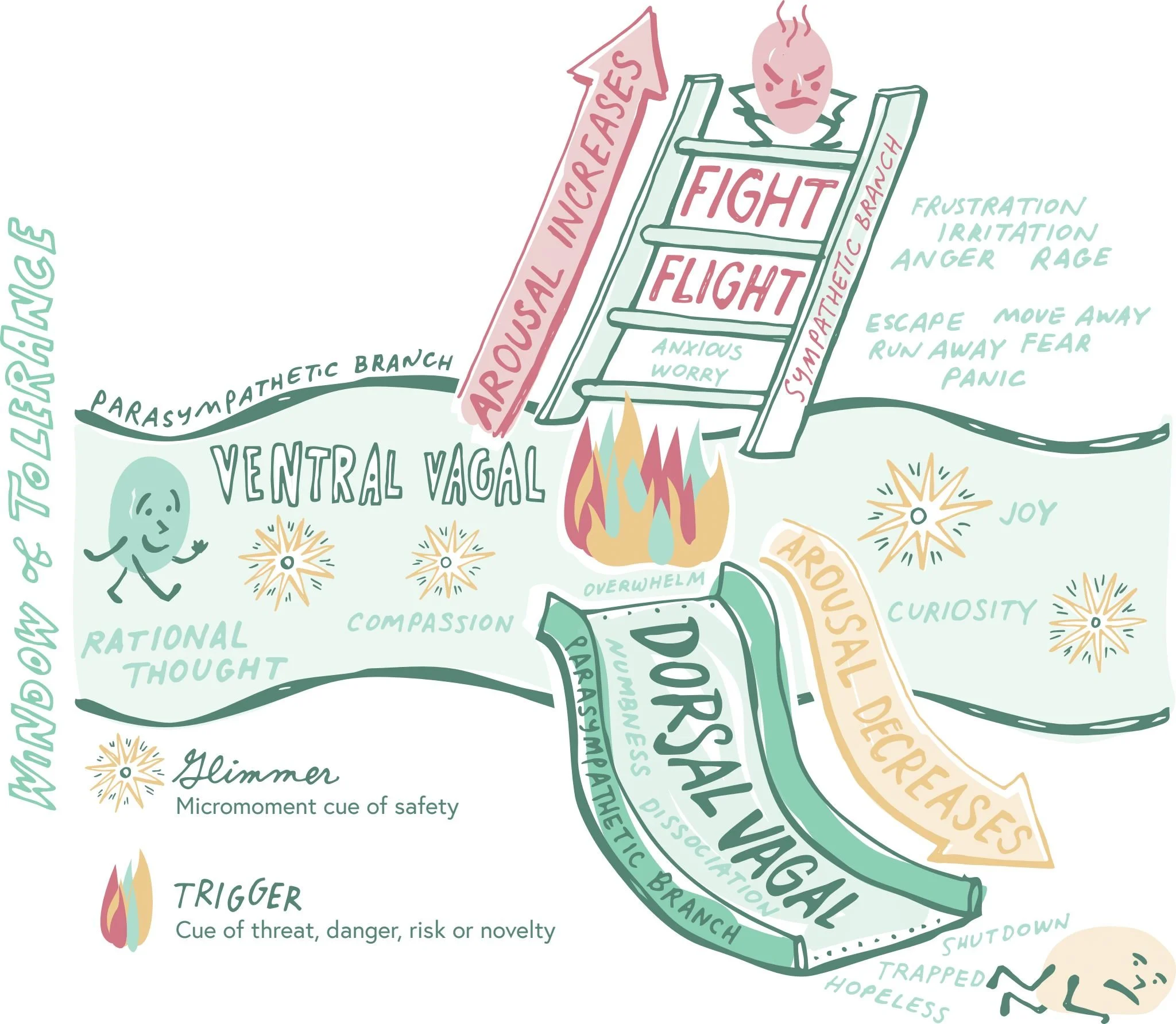
Figure A: The Polyvagal Theory—3 primary states of the nervous system (ventral vagal, sympathetic mobilization, dorsal vagal) according to an arousal continuum
In a dorsal vagal state, individuals:
Lack energy
Feel depleted, heavy, or physically exhausted.
Feel “out of it” / unseen
Disconnected, invisible, or floating away from reality.
Feel lost
Unsure of direction, purpose, or how to re-engage.
Feel alone
Isolated, withdrawn, and shut off from those around you
Now reimagine that student again. What might you do differently if you thought the student was shut down and feeling the way we describe an individual feels in a dorsal state? If you feel like you aren’t sure, I share some ideas below:
1. Notice
Notice the sensations or absence of sensation(s) in your body as you are standing or sitting in close physical proximity to the student. Our bodies unconsciously communicate with one another. Dr. Allan Schore, esteemed neuroscientist & attachment researcher, describes this a right brain to right brain communication.
2. Go slow
A nervous system in shut down needs breathing room but also benefits from a source of co-regulation nearby. As the adult, you can provide this co-regulatory presence to your student by going tuning into your own body and dropping your agenda in the moment.
Drop your agenda
Forget the academic expectation in the moment and instead, use your body as a guide for what is needed in the moment
Try a lil’ something
Try a little something to awaken the region of your body that seems flat, numb, unresponsive—a tap, a pinch, a slow exhale, move your eyes up, down, and all around
3. Keep it brief
Whatever you try, keep it very brief. A student in shut down may retreat further if our efforts further overwhelm them.
Reach for a sensory tool
Reach for a sensory tool (i.e. stretch noodle, mesh & marble, mad matter, weighted product) and use it to try and bring movement to the part(s) of your body that you notice feels offline. Do this as you are sitting or standing near the shutdown student. If the student expresses an interest in using the sensory tool, offer to take turns using it together.
Try a TRC® Core Practice
Try a10, 20, 30 second dose of a TRC® ACTIVATOR or a SETTLER (i.e. thymus thump; physiological sigh, angel stretch, Cook’s hook up, soft humming, karate chop tapping, etc.) in the presence of the student. See if your activation or settling signals their nervous system.